Four different consistencies in five days. Firm on Monday, unspeakable on Tuesday, perfectly fine again by Thursday, and you’ve changed nothing.
Puppy digestion is genuinely more variable than adult digestion, for reasons that are mostly developmental and mostly temporary. Knowing which wobbles are normal and which aren’t is the difference between a relaxed first year and a great deal of unnecessary worry – or, occasionally, missing something that matters.
Why puppy guts are so temperamental
Several systems are still under construction.
The microbiome is being built. A puppy is born with a near-sterile gut. It’s colonised in the hours and days after birth, shifts again at weaning, and carries on developing through the first year. A population still assembling itself is far less stable than a mature one.
Enzyme production is still adjusting. The machinery for digesting solid food is fairly new. Lactase, for instance, declines after weaning, which is why milk that was fine at four weeks causes trouble at fourteen.
Reserves are tiny. A small puppy has very little in the tank. What’s an inconvenience in an adult dog can become serious in a puppy within hours, and that’s the single most important difference to hold onto.
And everything goes in the mouth. Stones, bark, socks, cat litter, whatever’s on the pavement. Most puppy diarrhoea is straightforwardly explained by something the puppy ate when nobody was looking.
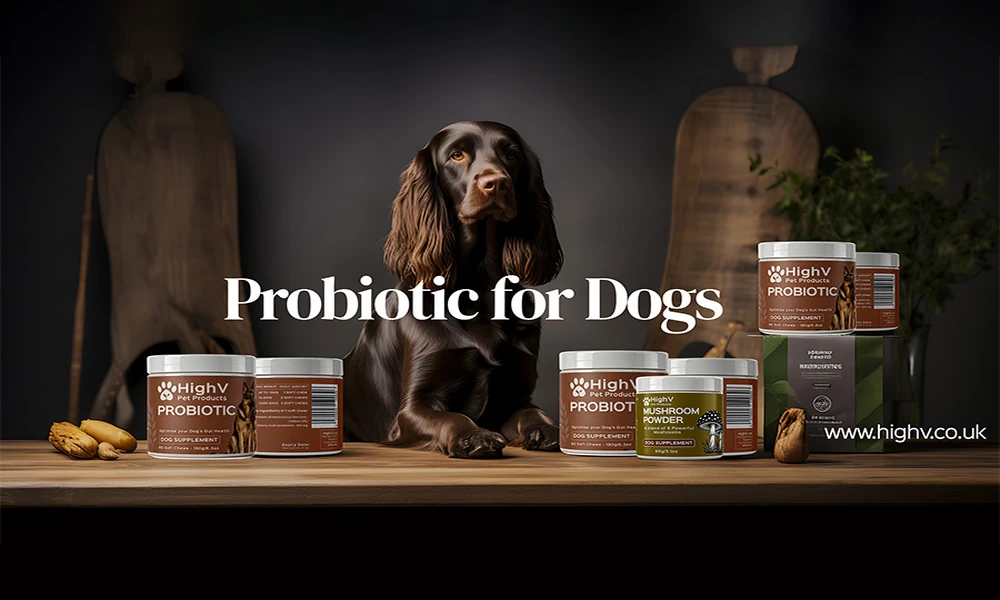
All of which means a puppy’s digestion is a work in progress rather than a broken version of an adult’s. It also means this is the period when steady support does the most good, because you’re helping a population establish itself rather than repairing one that’s been knocked about. The Best Probiotic for Dogs in the first year is simply one you can feed every single day – a stated CFU count, a named strain, and a minimum age your puppy actually meets.
The first fortnight home
The most disrupted two weeks of his life so far. He’s lost his mother, his littermates and everything familiar, all in one afternoon, and stress alone will loosen a puppy’s stools.
Keep him on whatever the breeder was feeding for at least two weeks. Get a bag from them if you can. Changing food on top of everything else is asking for trouble, and you’ll have no idea afterwards what caused what.
When you do change, transition over ten days minimum, and slower if he’s at all delicate.
Expect some looseness in the first week. It should settle. What shouldn’t happen is diarrhoea that’s watery, that comes with vomiting, or that leaves him flat.
Worming, which is not optional
Almost all puppies are born with roundworm, passed from the mother before birth or through her milk. This isn’t a reflection on the breeder – it’s simply how the parasite works.
Puppies are typically wormed every two weeks from around two weeks old until twelve weeks, then monthly until six months. Your vet will set the schedule and it’s worth following it exactly rather than approximately.
Worms cause soft stools, a pot-bellied appearance, poor coat, and sometimes a puppy who eats well and doesn’t gain. Roundworm is also transmissible to people, particularly children, which is a good reason to be rigorous about it and about hand-washing.
Giardia is the other common one, picked up from puddles, streams and contaminated ground. It’s a frequent cause of stubbornly soft stools in puppies and needs specific treatment rather than a probiotic.
Feeding frequency by age
Puppies can’t take much at once and can’t go long without.
Up to twelve weeks: four meals a day. Three to six months: three meals a day. Six months onwards: two meals a day for most dogs.
Small breeds need to be more careful than large ones about gaps between meals, because they’re prone to low blood sugar. A toy breed puppy who misses meals can become hypoglycaemic quickly – wobbly, weak, disoriented – and that’s a vet trip.
Never fast a puppy. The advice about withholding food for twenty-four hours with diarrhoea applies to healthy adults and not to puppies, who don’t have the reserves for it.
Puppy food, and why it isn’t marketing
Growing puppies need different ratios from adult dogs, not just more calories.
For large and giant breeds this matters most. Calcium and phosphorus levels and total energy density affect how fast the skeleton grows, and growing too fast is associated with developmental joint problems. A large-breed puppy food is formulated to control this, and it’s one of the few areas where the specific product genuinely matters.
Resist the urge to grow him quickly. A lean puppy who grows steadily has better joints at eight than a well-covered one who shot up.
Supporting the gut while it settles
Because the population is still establishing, this is arguably the period when support is most worth doing – and there’s research suggesting early-life supplementation may have effects reaching beyond digestion into immune development.
When you’re picking a product, the criteria at this age are the same as for adults, with one addition. A stated CFU count per chew rather than per hundred grams. A named strain rather than “probiotics”. A prebiotic alongside it. And a minimum age on the label that your puppy actually meets – many are suitable from twelve weeks, and some aren’t.
Then feed it daily rather than reaching for it when things go wrong.
Teething, and the mouthing phase
From around three to six months he’ll be losing puppy teeth and chewing everything within reach. Some of it gets swallowed.
Sock, stone, corn cob, bit of a toy, the corner of a rug. Most passes through. Some doesn’t, and an obstruction is a surgical emergency – repeated vomiting, no appetite, straining with nothing produced, a painful abdomen, and a puppy who’s clearly unwell.
If you know he’s swallowed something and it hasn’t appeared within a couple of days, ring the vet rather than waiting to see.
Give him appropriate things to chew and manage the rest with gates and tidiness. You will not train a teething puppy out of chewing.
The first walks, and what he’ll try to eat
Once he’s out and about, the range of things available to him expands enormously and his judgement does not.
Expect him to try goose droppings, fox faeces, dead things, chewing gum, discarded chips and anything a horse has left behind. Most of it causes nothing worse than a bad day. Some of it carries parasites, and fox faeces in particular is a route for several.
Teach a proper “leave it” early and pay generously for it – a puppy who spits something out for a piece of cheese is a puppy who’ll keep doing it. Practise it in the garden with boring objects long before you need it on a towpath.
A long line gives you enough control to intervene without constantly hauling him about, and it’s considerably better than an extending lead for this.
If he does eat something questionable, note the date and what it was. If loose stools follow two days later, you’ve got your answer rather than a mystery.
Toilet training and what the stools tell you
The two jobs overlap, and one informs the other.
A puppy who is producing well-formed stools two or three times a day at predictable intervals is much easier to house-train than one whose output is unpredictable. If toilet training is going badly, look at the stools before you conclude he isn’t getting it.
Feed at set times rather than leaving food down. What goes in on a schedule comes out on a schedule, and that’s most of house-training solved.
Most puppies need to go within about twenty minutes of eating, on waking, and after play. Take him out at all three rather than waiting for a signal he hasn’t learned to give yet.
And clean any indoor accidents with an enzymatic cleaner. Anything ammonia-based smells like urine to a dog and marks the spot as a toilet.
The one that kills
Parvovirus is still around in the UK, it’s brutal, and it starts exactly like a routine upset: vomiting, then diarrhoea, often bloody, in a puppy who goes downhill fast.
Unvaccinated and partly-vaccinated puppies are at real risk. It survives in the environment for months and ordinary household disinfectants don’t touch it.
Any puppy with vomiting and diarrhoea together, particularly before the vaccination course is complete, is a same-day phone call. Not a wait-and-see. Ring first rather than turning up, because they’ll want to keep him away from the waiting room.
Dehydration happens fast
The reason the threshold is so much lower for puppies.
Two quick checks. Lift the skin over the shoulders and let go – it should spring straight back. Press a finger on the gum; the pale patch should refill with colour in under two seconds, and the gums should be moist rather than tacky.
A puppy who is lethargic, whose gums are pale or dry, or who won’t drink, needs a vet the same day.
Normal, and not normal
Normal: softer stools than an adult, going four or five times a day, an occasional off day after something unusual, a wobble after vaccination, a wobble in the first week home.
Not normal: watery diarrhoea, blood, vomiting alongside diarrhoea, a puppy who won’t eat at all, lethargy, a swollen or painful abdomen, no weight gain over a fortnight, or diarrhoea that persists more than twenty-four hours.
The rule of thumb: for adult dogs you give it forty-eight hours. For puppies, twelve.
What it looks like when it settles
Most puppies become substantially more reliable between six and twelve months as the microbiome matures and the mouthing phase passes.
If yours hasn’t – if he’s still unpredictable at a year on a consistent diet with worming up to date – that’s worth investigating properly rather than accepting. Pooled faecal samples across three days, a blood panel, and a conversation about food-responsive disease.
The dogs who end up with lifelong sensitive stomachs are quite often the ones whose puppy problems were never quite resolved, just tolerated until everyone stopped noticing.