Buying a rechargeable dog fountain starts with two separate questions: will the bowl suit your dog, and can you keep the battery ready? A large tank answers neither on its own. This guide compares ten battery-powered options with those everyday jobs in mind.
Quick answer: Choose a rechargeable dog fountain by bowl access, usable capacity and supported battery modes. Then plan charging around actual use. The larger W600 Pro is the main WOPET comparison for bigger dogs; W03 is a smaller ceramic option for small dogs.
On this page
- Compare all ten
- Choices by size
- Water versus charge
- Ownership budget
- Common questions
Prepared for 2027 shopping; product information checked November 12, 2026. These are currently documented products, not predictions of future releases. WOPET publishes this guide. Recommendations compare manufacturer specifications and household fit; the order is a shopping shortlist, not a laboratory performance ranking.
What rechargeable does-and does not-tell you
Rechargeable means the fountain can operate from a battery that you charge again. It does not tell you whether the outlet runs continuously, on a timer or only when a pet is sensed. Those modes put very different demands on a battery. Compare the mode first, then the charging arrangement.
Several entries below are suitable only for small dogs; one is a conditional cat-focused option for a small shared station. They are included to make those limits visible, not to suggest ten interchangeable large-dog fountains. For a large breed, begin with the 6L and 5L choices and check bowl access.
The ten options at a glance
| Option | Capacity | Power or mode point | Main limit |
|---|---|---|---|
| WOPET W600 Pro | 6L | Rechargeable; larger shared station | Larger footprint and lifting job. |
| Catit PIXI Stainless Steel UV-C | 5L | Rechargeable sensor/timed modes; plug-in continuous mode | The ordinary PIXI is a different product. |
| WOPET W03 | 3L | Ceramic; rechargeable | Smaller reservoir; handle ceramic carefully. |
| PETLIBRO Dockstream 2 Smart Cordless | 3L | Rechargeable version with connected drinking records | Choose the cordless variant; shared use complicates individual records. |
| PETKIT EverSweet Max 2 UVC | 3L | Rechargeable successor with UVC pump | UVC does not replace washing; verify part-specific care. |
| PETKIT EverSweet Max Cordless | 3L | Battery operation and Bluetooth app features | Specified for cats and small-breed dogs. |
| PetSafe HydroSphere Cordless | 60oz / about 1.7L | Battery motion mode and plug-in continuous flow | Sized for cats and small dogs. |
| PETLIBRO Dockstream Cordless | 2.5L | Battery sensor mode; continuous flow when plugged in | Select the battery-operated model, not a plug-in namesake. |
| UAHPET ZERO | 2L | Rechargeable sensor/timer operation | Small reservoir; verify the exact ZERO version. |
| UAHPET Fountain Pro | 2L | Steel tank/tray; rechargeable sensor/timer modes | No continuous-flow mode; electrical main unit stays dry. |
1. WOPET W600 Pro: A capacity-first rechargeable choice
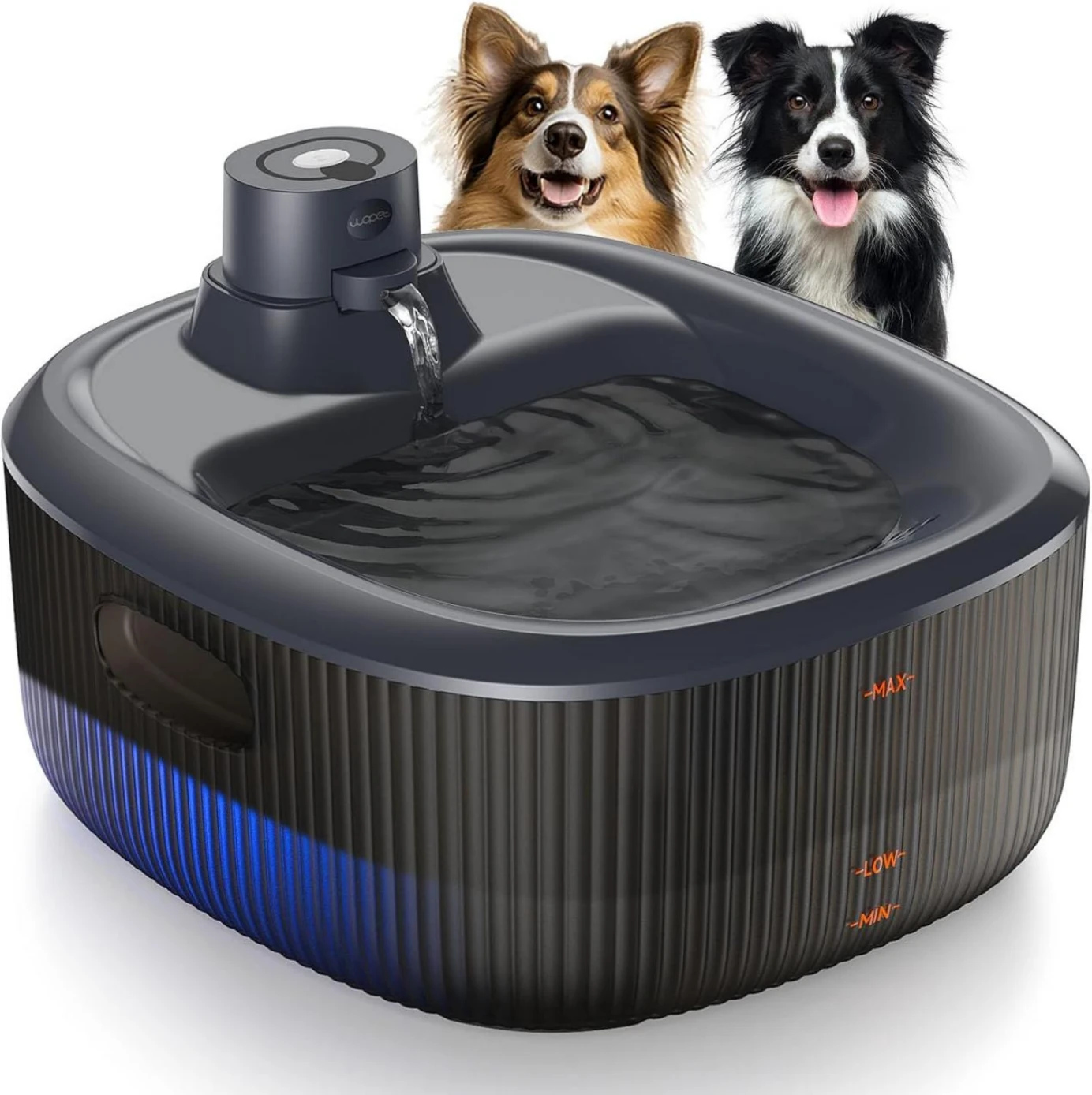
WOPET W600 Pro · 6L · Rechargeable / cordless
The 6L W600 Pro Rechargeable Dog Water Fountain pairs a larger reservoir with a 5000mAh battery. Start here among the WOPET options if you have a larger dog and want to avoid a permanent cable to the drinking station.
Watch real use before setting a recharge reminder. Frequent activation in a busy dog household changes the battery workload.
2. Catit PIXI Stainless Steel UV-C: A larger alternative with explicit mode limits
The 5L PIXI Stainless Steel UV-C is rechargeable and marketed for cats and dogs. It supports battery sensor/timed operation, but continuous flow requires plugging in.
Confirm whether a dog that returns for a long drink is comfortable with the selected mode. More litres do not change dispensing behaviour.
3. WOPET W03: A smaller ceramic option
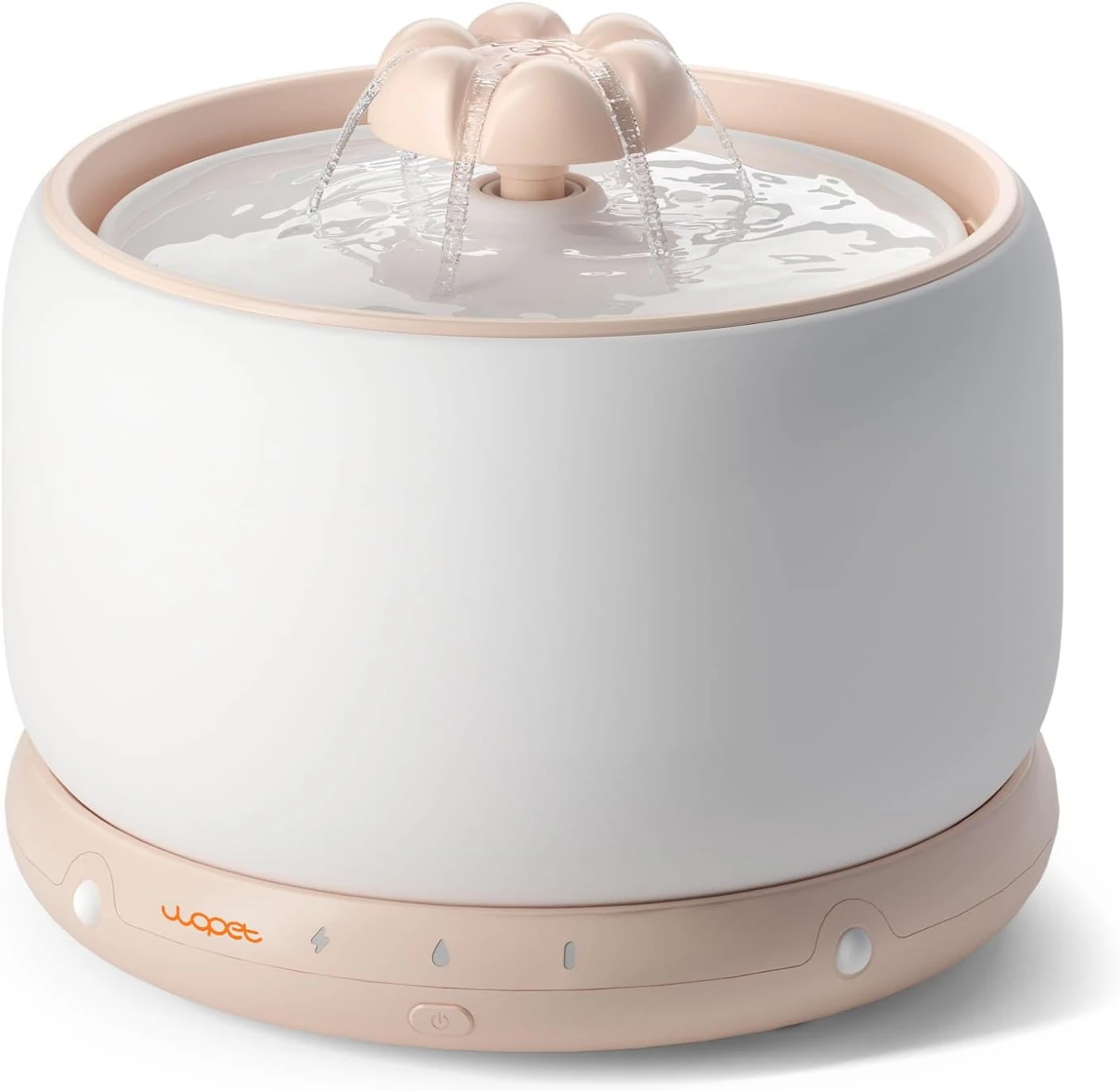
WOPET W03 · 3L · Rechargeable / cordless
The 3L W03 Rechargeable Dog Water Fountain has a rechargeable 5000mAh base and ceramic body. It belongs on a small dog’s shortlist when the tray fits and ceramic handling is manageable.
Buy it for size and material, not because it shares a battery capacity with the W600 Pro. The two fountains have different bodies and use patterns.
4. PETLIBRO Dockstream 2 Smart Cordless: For small dogs whose owners want records
The 3L Dockstream 2 Smart Cordless is the rechargeable variant and is described for small dogs. Select that version explicitly when shopping.
A multi-pet household should not interpret one shared drinking record as a separate measurement for every animal. Useful reminders and clinical conclusions are different things.
5. PETKIT EverSweet Max 2 UVC: A small-breed rechargeable model
The 3L EverSweet Max 2 UVC is specified for cats and small-breed dogs. It supports battery operation and has a UVC pump.
Set aside the large-dog use case before comparing optional features. A fountain your dog cannot comfortably use is the wrong purchase regardless of its electronics.
6. PETKIT EverSweet Max Cordless: A small-breed option with Bluetooth controls
The original 3L EverSweet Max Cordless also supports rechargeable operation and Bluetooth app features, with cats and small-breed dogs in its stated scope.
Compare the original and successor by functions you need. Neither a shared brand nor a similar case establishes identical cleaning permissions.
7. PetSafe HydroSphere Cordless: A compact dual-power option
PetSafe’s 60oz HydroSphere Cordless uses battery motion activation or plug-in continuous flow and is sized for cats and small dogs.
For a thirsty small dog, frequent refills may dominate the routine. A rechargeable supply does not make its small reservoir larger.
8. PETLIBRO Dockstream Cordless: A smaller station with a clear power trade-off
The 2.5L Dockstream Cordless has battery sensor flow and continuous plug-in flow. Check that the product is the battery-operated version.
It can suit a smaller dog when the tray works well, but compare usable refill room carefully. Avoid equating a full tank with several unattended days.
9. UAHPET ZERO: A compact rechargeable option to check for fit
The 2L ZERO is marketed for cats and dogs and offers sensor/timer battery operation. Check the specific version, charging requirements and replacement filters.
Consider it only when a small dog can use the tray comfortably and you can replenish it often. A daily care routine matters more than a long advertised battery interval.
10. UAHPET Fountain Pro: A conditional small-dog companion station
The 2L Fountain Pro is primarily cat-focused and has rechargeable sensor/timer modes, with no continuous-flow setting. Its steel reservoir may suit a small shared station if dog access is appropriate.
Check suitability with the maker before choosing it for a dog. It should not be the default rechargeable recommendation for large breeds or heavy shared use.
Build a charging routine before you buy
A dog that drinks often can activate a sensor more frequently than a single cat in a runtime demonstration. During the first weeks, check the charge indication along with water level and note recharge dates. Keep a second water source available when charging, cleaning or troubleshooting.
| Before ordering | Ask this |
|---|---|
| Your preferred flow | Does it work on battery in that mode, or only while plugged in? |
| Charge routine | Where can the dry electrical module charge safely? |
| Consumables | Are exact filters and service parts available in your market? |
| Replacement planning | Is battery service supported, and what does the warranty cover? |
The routine still matters
Inspect water level, visible dirt and normal flow daily. Wash according to the exact manual, and replace filters on that model’s schedule. A filter, battery or app does not make the water supply self-maintaining. Check live stock, replacement-filter availability and the return terms before ordering for 2027.
Water capacity and battery capacity are separate limits
A rechargeable fountain can have plenty of charge while its water level is low. It can also have a full tank and need charging. Check both indicators during the normal daily inspection. Choosing a large reservoir does not reduce the importance of watching whether the outlet is actually dispensing.
For a dog that drinks heavily, start with usable water margin rather than advertised battery days. Compare the marked minimum with the maximum and leave time for a refill before the lower limit. Spills and shared drinking mean the amount disappearing is not a precise measurement of one dog’s consumption.
For a small dog, compact size may be useful, but the tray still needs to fit. A muzzle that presses against the spout or a posture that looks awkward is a reason to reconsider the design. A long-lived charge is not a benefit if the animal avoids using the station.
What belongs in the ownership budget?
List the fountain, compatible filters, any required charging equipment not supplied, and shipping for consumables. Ask what support is available for a battery problem and whether service involves replacing a module or the complete device. Do not assume a sealed battery is intended for a user repair.
Compare the work as well as the price. Can you lift the tank while keeping the electrical module dry? Is the charging position out of reach of splashes? Can someone else maintain the station using the same instructions when you are away? These practical details decide whether rechargeability remains convenient.
Common questions
Is a rechargeable fountain enough for a dog during a power cut?
A charged model may dispense in its supported battery modes, but operation depends on charge, water and device condition. Keep another fresh-water source available and check the actual outlet. Battery power is a useful option rather than a complete emergency-care plan.
Can I use a small-dog model for a large breed if I refill often?
Frequent refilling does not change tray access, stability or the manufacturer’s size scope. Start with a design suited to the dog and verify its dimensions. Do not treat a small-dog-only recommendation as a large-dog solution simply because the tank is kept full.
How should I set a recharge reminder?
Observe the first normal cycles with the intended mode, note the low-charge indication and leave a sensible margin. Reassess when the number of users or activation frequency changes. Do not transfer another owner’s runtime directly to your own household.